


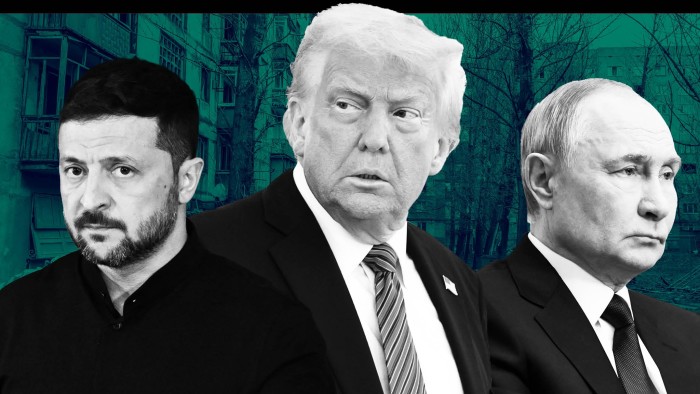
For Donald Trump, Monday’s call with Vladimir Putin evoked the hope of a brilliant future of “Granescala trade” between Russia and the United States “, when this catastrophic” Bloodbath “ends.
Yuri Ushakov, foreign policy advisor to the Russian leader, said that the two -hour conversation tone was so friendly that none of the president wanted to be the first to put the phone.
For the Ukrainians and allies in Europe, he felt like a conform.
It was not just that the president of the United States did not seem to put pressure on Russia to achieve a high fire. According to his reading of the call, Trump also made the United States withdraw as a mediator in the efforts to end the war, leaving Moscow and Kyiv to solve things for themselves.
The president of Ukraine, Volodymyr Zenskyy, warned about the count. “It is crucial for all of us that the United States does not distance ourselves from the conversations and the search for peace, because the only one that benefits from that is Putin,” he said in a statement after talking to Trump.

For observers, it was a turning point after more than three years of conflict. A president who promised to finish the Ukraine War on the first day of his second term seemed to be washing his hands from the effort and holding Ukraine to the mercy of his invader. The call confirmed the worst fears of Europeans: that the president of the United States, seduced by Putin oxides, was ready to pivot Moscow and sell to kyiv.
Trump had a suggestion briefly for whom he could replace the United States as a mediator: Pope Leo XIV. “The Vatican ……
In a call to European leaders after having spoken with Putin, Trump noted not only that he was disconnecting, but also intends to apply additional pressure on Moscow while bilateral conversations between Russia and Ukraine Way, remembering.
That represented a turn to Trump. Approximately a week ago, he had joined other Western leaders to threaten to impose new punitive measures to Russia if he did not implement immediate fire.
Trump himself admitted journalists later on Monday that he had not only reiterated his previous Putin demands to stop attacks against civil areas in Ukraine.
“This call with Trump was a victory for Putin,” said Steven Pifer, former United States ambassador to Ukraine now at the International Security and Cooperation Center at Stanford University. “He made a high fire won in the short term, so Russia can continue the war. And additional sanctions will not be applied yet.”
Trump and Putin seemed to have agreed that Russia and Ukraine would celebrate direct conversations, continuing negotiations in Istanbul since last Friday.
Putin said Russia was ready to work with Ukraine in a “memorandum on the possible future peace agreement.” That would include the “principles on which a peace agreement would be based” and a “possible fire for a certain amount of time, if certain agreements are reached.”
However, he had confusion about what Putin was talking about.
A senior Ukrainian official familiar with the calls said about the idea of the memorandum that “nobody knows what it is, what is the reason for [and] Why does it matter. “Zenskyy himself told journalists on Monday night that the memorandum proposal was” unknown “to him.
“The Russians will conduct low level conversations, exchange several documents and, meanwhile, will continue to fight,” said Bill Taylor, who served as an ambassador of the United States in Ukraine since 2006-09. “How much more time Trump will endure with all this storage?”

The United States desire to disconnect has been marked for weeks, by Trump himself, but also by Secretary of State Marco Rubio and vice president JD Vance, who have repeatedly expressed frustration with Russia and Ukraine to the same extent. Vance told reporters on Monday that the United States could say: “This is not our war.”
“We are going to try to finish it, but if we cannot finish it, we can say:” Do you know what? It is worth trying, but we are not doing it anymore. “
Trump reiterated that when he told journalists in the White House that something was going to happen “to end the war.” And if not, simply go back and will move on.
Some experts see Trump’s desire to disconnect as understandable. “The approach on each side has been to make Trump get angry on the other side, and that was destructive in its essence,” said Peter Slezkine, of the group of experts from the Stimson Center. “If you can force the two parties to talk to each other and get out of the scene, that may be necessary for things to move.”
But Trump now seemed more interested in approaching Moscow than in resolving the war, others said.
“At this point, Trump seems to see the normalization of Russian-United States relations as an end in Iself,” said Andrew Weiss, Vice President of Carnegie Endowment for International Peace. “Everything else is subordinated to that goal.”
Putin’s apparent will to postpone Russia’s confidence could be the military progress of his large -scale invasion of Ukraine, where operations has increased along large sections of the front line.
A Ukrainian military spokesman said that the “heavy battles” were in his on the strategic city of Pokrovsk in eastern Ukraine, and north of Toretsk nearby. A road that serves as a crucial logistics center was under a regular drone attack, threatening Ukraine operations in the area, the soldiers said.

Deepstate, a Ukrainian analytical group near the army, described the situation as “unfavorable” for kyiv’s forces and said that Russian troops were “pushing through positions and approaching the Russk Russk Control administrative region completely.
The Deepstate folder, where it tracks the changes in the front line, shows the Russians less than 5 km from that border where the fight is more intense.
Capturing the entire East Region of Donetsk, along with the neighboring regions of Luhansk, Kherson and Zaporizhzhia, the other three areas that attached in 2022, remains a key military objective for Moscow. His army has suffered strong losses in the search or this goal. In conversations with Ukrainian officials in Türkiye last week, Russia caused any fire to be conditioned to kyiv withdrawing all its forces from the four regions.
Rob Lee, a senior member of the Foreign Policy Research Institute, said that Russia was successful by advancing along the front line and was managing to recruit soldiers in large quantities.
“Millionarily, I think Russia can sustain the fight for the moment, given its sustained recruitment of volunteers,” he said. “Russia’s leadership probably believes that they can still improve their position on the battlefield.”
As summer approached, climatic conditions would become more conducive to offensive operations, which Russia could, Lee said.
“Russia has not yet achieved its minimum objective to occupy all the Donetsk and Luhansk regions.
Additional James Politi reports in Washington
]